Going Clubbing: Deaf Theaters and Clubs of France
"So, how many times did you go out clubbing while you were on your 'study abroad'?"
Truthfully, twice! Though not in the way you might be thinking of.
Deaf theaters and clubs have been a key aspect of Deaf culture in multiple countries. However, small communities and the primary use of social media as a means to connect with other Deaf people means that the prevalence of these theaters and communities has dwindled. These experiences I had in France with Deaf theaters and clubs were the first interaction I'd ever had with those spaces, and both were unforgettable and incredibly enjoyable.
Express Yourself: The International Visual Theater
I'd previously heard only of Deaf theaters in the US, like Deaf West and National Theater of the Deaf. They're not as well known as mainstream theaters around the world, but sometimes they come into the spotlight, as Deaf West did a few years ago with their showing of "Spring Awakening" entirely in sign language. However, I had never gotten the chance to be in one of those theaters or meet people who worked as actors, so when I walked into the bright yellow building that housed the International Visual Theater, I had no idea what to expect.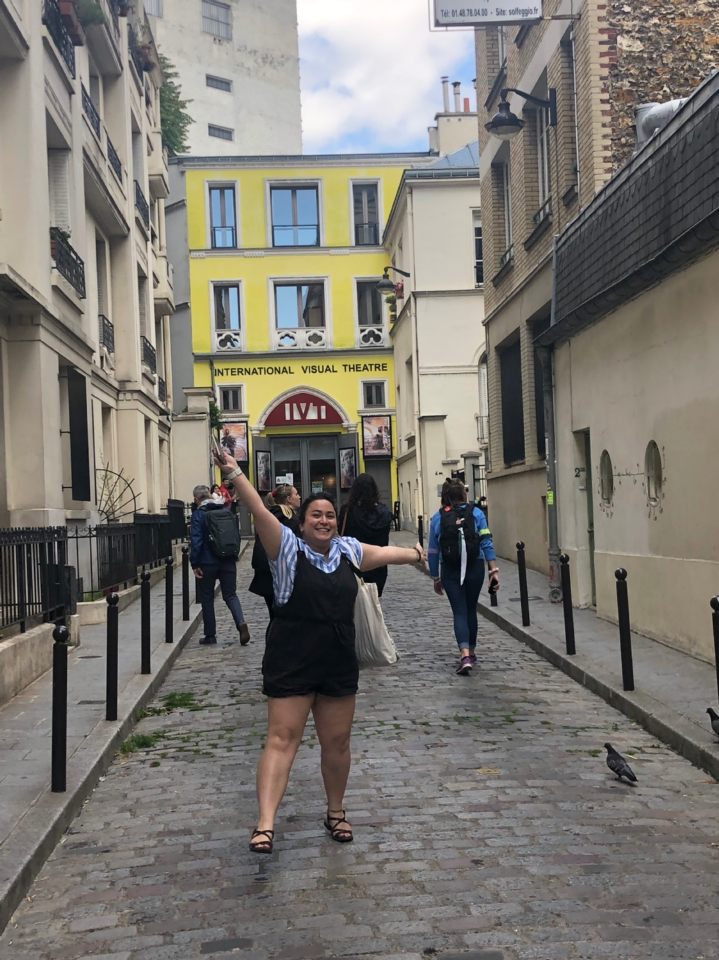 |
| Don't let the joy in my face fool you. I was in the process of falling over in this picture. |
We also got to see posters for some of the shows that the theater had done in the past, and while I had never heard of some of them, there were others that were popular in France as well as the States, so it was easy to see that they had a blend of plays. We also got a full tour of the theater, which was absolutely amazing. I would love to go back and attend one of their plays in the future.
Learning From The Experts: Deaf Clubs
 |
| View from the first Deaf club we visited in Lyon |
While in Lyon, we got to go to two different Deaf club events. At the first, we got to see a presentation given by our very own professor about Laurent Clerc and comparing ASL to LSF, which was incredibly fun, even when people started asking about our opinion on Donald Trump, which was fun to explain in a language I barely knew that could generously be called my "fourth language". We socialized with the other attendees before and after the presentation, and much of our conversation was asking about certain signs in ASL and asking why we signed them that way.
Many of them were perplexed by the fact that there isn't a clear explanation to a lot of the signs in ASL, it's just... that's the sign. That's what we're taught, so that's what we use. Very American.
The environment the whole time was incredibly warm and inviting. Everybody was so friendly and kind, insisting we eat more at every turn, or asking if we were understanding what was happening. Our second experience was no different. This time, we got to see two presentations, one on Claudius Forestier and one on the dark parts of Deaf history (oralism, audism in France, et cetera). They were enlightening and incredibly interesting, as they were topics we either had very little knowledge of or only knew about though the lens of American Deaf history. We also got to share meals with other attendees, which, again, led to the same conversations: exchange of signs, discussions of Deaf culture in France versus America, and learning about each others cultures. They were all very concerned about the fact that we had no sign for "bon appetit", continually asking what we signed before a meal and getting very upset at the answer: nothing.
What surprised me the most about these clubs was how collaborative the conversations were. Since Deaf history is largely left out of the mainstream and buried under mountains of discrimination, it's up to these clubs and communities to come together and piece together their history from what each person knows. The presentations would be largely solo and comprehensive, but every once in a while someone would come forth with supplementary information or a different story. Even if the information opposed that given by the presenter, it was always given in a respectful and calm way, and people could come up at any time and as many times as they liked. It was amazing to see people work together this way to strengthen their understanding of a misunderstood history. I wish we could have gone to more events like these.


Comments
Post a Comment